Showing posts with label Essay. Show all posts

Wednesday, November 5, 2014

Essay Week 12: Reviewing Celtic Fairy Tales


This week, I read the stories from Celtic Fairy Tales. Recently, it’s come to my attention that this will be the last unit I need to read and review to have enough points to make an A in this class! I find it hard to believe that this semester is coming to a close, but I’m glad that I was able to read stories I enjoyed for my last weekly unit.

I found the folktales in this unit to be complex and unpredictable, which is something I like. I know there are a lot of overarching motifs and themes in folktales, which is also cool, but when you’re reading about 20 every week, it’s nice to see new, unexpected stuff. I also like fairy tells with clever endings or endings that make you think, and this unit definitely provided some of those. Of course, in this unit there was one story that closely resembled the story we know as Snow White, and I enjoyed that as well.

In the overview, it is stated these Celtic fairy tales draw on a wide range of Celtic sources such as Irish, Scottish, Welsh, and Cornish, and I think this helps to make the unit as a whole more interesting. The subject matter and tone of this collection of  fairy tales are quite varied. Some were humorous and others were sad. All in all, it was a good mix.

Again, the length of the stories stayed steady around a page. This is my personal preference for readings. I also liked the traditional illustrations provided. While there weren’t notes on every story, the notes that were provided were really helpful. For example, the clarification on The Shee An Gannon and the Gruagach Gaire helped make a lot more sense of everything. I would’ve had no idea that “Gruagach Gaire" actually means "The Laughing Goblin.”

(Illustration of a leprechaun from Field of Boliauns, illustrated by John D. Batten)


Friday, October 31, 2014

Essay Week 11: Using Apostrophes and Apostrophe Comic


This comic is funny because it’s so painfully accurate. In the comic, an old man and an old woman are depicted sitting at a table. The old man asks the old woman if she is making any New Year’s resolutions, and she tells him that she will try to criticize him less. In response, the old man tell the old woman “Thanks dear. Your great.” The old woman corrects him and he says, “I agree. We’re both great.”

I think the first thing that makes this comic funny is the dynamic between the two elderly people. We all know people like this, which makes the comic relatable. Next, the old woman says at the beginning that she is going to try to stop criticizing the old man as part of her New Year’s resolution, but she immediately criticizes him when he makes a usage error. I thought this was really humorous. She seemed to have the best intentions, but she couldn’t let the error slide. I’m constantly correcting people as well, even over text message. Errors like that drive me up a well. Lastly, the old man doesn’t realize his error, so he doesn’t understand what the old woman is really saying when he is being corrected. He is oblivious, like so many people seem to be when it comes to contractions and apostrophe usage.

I also visited The Oatmeal’s How To Use An Apostrophe page. The examples they gave were funny and clever and could be potentially useful for people who don’t know the difference between your/you’re, its/it’s, and so on. At the bottom, the illustration suggests to hold off on using apostrophes when in doubt. I don’t know how good of a rule this really is, but still. I think usage rules are something everybody should be sure to learn. They aren’t that difficult and they make a big difference.


Tuesday, October 21, 2014

Essay Week 10: Reviewing Eskimo Folktales


This week, I read the stories from Eskimo Folktales. These folktales feature a variety of subject matter. Within this Eskimo Folktales unit, you will find stories about the spirit world and village shamans. There are also stories of evil spirits, zombies, ghosts, and cannibalism. However, all of the stories aren’t super extreme and dark. Some of them are about animals or family dynamics and, of course, there is a creation story. There weren’t really any general themes throughout, but I didn’t mind. The varied subject matter kept things interesting.

The Eskimo Folktales are actually Canadian Inuit stories recorded by a polar explorer in the early years of the 20th century. After reading a few of the stories, I was curious about the origin of the names of characters, so it was interesting to me to find out they were Canadian Inuit names. The names were really long and complicated. I couldn’t even type them for my reading diary; I had to copy them and paste them in every time.

I enjoyed the illustrations that were included, even though a lot of them were bizarre. They looked hand-drawn and even though they weren’t in color, there was a lot of detail in most of the illustrations.

All of these stories were one page stories. This length is preferable to stories that are one long, continuous thing. As I normally do, I completed all of the readings in one sitting. This helps me keep my thoughts together and once I get going, it’s just easier to make some time and take care of it. Also, this means I can take care of both of my declarations at once.

Some of these stories had notes and some did not. I appreciated the notes that were included, but the stories without the notes weren’t difficult to understand. As mentioned in the notes in the beginning of the unit, these stories are recorded in a way that’s stylisticly similar to the way the stories would likely have been told in oral tradition. I think this makes the stories pass in a lively way.

(Illustration of Nukúnguasik done by a native Eskimo artists, Eskimo Folktales unit)

Tuesday, October 14, 2014

Essay Week 9: High School & College Writing Experience


I feel like I’ve had my fair share of writing experiences so far. For the most part, I enjoy writing and it’s always been something I’ve been told I have a knack for. I’ve enjoyed writing/language/English-type classes more than math and sciences since I was young. In high school, I was involved in several communications-based extracurriculars. I was on yearbook staff for two years, newspaper staff for a year and a half, and radio/television staff for two years. I wouldn’t necessarily have had to take a writing position in these extracurriculars, but that’s almost always where I found myself. I was a feature writer for yearbook and an op-ed columnist for the newspaper. I did a lot through the radio/television program and a lot of it was based around writing. I wrote scripts, I wrote on-air spots, I wrote news stories to be read on the air…and so on.

I definitely think honors and AP English classes in high school helped improve my general writing abilities, and all of my extracurriculars helped me get used to writing in different styles and about different things. Research papers are one thing I have never enjoyed writing, but aside from those, I get some degree of enjoyment out of most writing assignments. I usually like writing analyses of novels and stuff like that. I think exploring themes and characters in works of literature can be really interesting. I also like writing fiction as long as I have an idea of where I’m going. When I don’t have a clear starting point, I’m not very creative.

Sometimes the joy of writing comes from the process and what I learn during it. Other times, the joy comes from finishing and being proud of what I’ve accomplished. At OU, I’ve taken a good amount of writing-based classes, partly because my major (public relations) requires it and partially because I’m interested in them. My favorite one so far has been the Expo class I took spring of my freshman year. The class topic was counterculture and the professor was one of the most well-spoken and helpful instructors I’ve ever had. In the future, I think technical writing will be important for my job(s), but I hope to be able to do some creative writing from time to time as well!

(A fountain pen I probably couldn't write with, Wikipedia)

Tuesday, September 30, 2014

Essay Week 7: Future of Written Media


The future of written media is definitely going to be quite different than the written media I was used to while growing up. When I was in elementary school, written media consisted more or less solely of physical copies of books, workbooks, and maybe some magazines from time to time. My mother works at an elementary school, and today, kids there do at least half of their work on iPads. Each child is given their own iPad and taught how to use several programs on it They use iPads for everything from storing and reading books to doing math exercises.

I think it’s awesome that children are becoming familiar with new technological forms, but I also think this will have some drawbacks. On the plus side, iPads save the schools from having to buy and transport books. In the long run, they’re probably saving money. Having everything on one little iPad that can easily be taken from place to place is more convenient for everybody involved. However, I believe that swapping reading from books and writing with pen and paper to reading from a screen and writing on a screen with a stylus will make a difference in the long run.

Schools have been cutting the amount of time given to teaching cursive and penmanship for several years now, but the introduction of such heavy iPad use to the curriculum means that students will be practicing writing less and less. In addition, growing up in a world so filled with jargon and abbreviation everywhere hasn’t exactly led today’s students to believe that things like writing cursive and addressing formal letters are important. They have no incentive to want to learn these things.

Things are changing whether we like it or not, and it’s undeniably a good thing that the younger generations will be prepared to take on these new digital technologies. However, I think it’s also important to look at what is being sacrificed in this trade-off.

(Apple iPad, Wikipedia)

Wednesday, September 24, 2014

Essay Week 6: Tibetan Folktales


This week, I read the stories from Tibetan Folktales. It took me a little deliberation before I decided on this unit, because there were a lot that seemed interesting in the Asia/Africa selection we’re currently in. In the end, I was happy with my choice.

The Tibetan Folktales featured a variety of subject matter, including ghosts, wizards, lots of animals, and many other things. Each story was accompanied by a Tibetan proverb. I liked this touch. Sometimes the proverbs didn’t seem to have much to do with the stories themselves, but they were still interesting to read. When they did connect to the story, it was even better.

I liked the length of the stories in this unit. In my opinion, they were long enough to successfully set the scene and tell a story without being too long to the point of becoming uninteresting. As I normally do, I completed all of the readings in one sitting. This helps me keep my thoughts together and once I get going, it’s just easier to make some time and take care of it.

I thought the notes on this reading were helpful. However, these stories were straightforward enough that I think readers would normally be okay without them.

My favorite stories this week (and, consequently, the only ones I took notes on) were all about animals. I think this might be influenced by the fact that I’ve decided to focus my storybook on animal stories, so I pay closer attention to animal stories. I find that somehow, animal stories make morals more accessible.

There weren’t any stories in this unit that I hated, and I really don’t think there have been any stories in any unit so far that I have completely hated. Of course, there are stories that I like better than others or stories that have endings I disagree with, but that’s okay.

(Illustration from one of the Tibetan Folktales, Blogspot)


Wednesday, September 17, 2014

Essay Week 5: The Earliest Ancient Texts


I found this comic to be very clever and humorous. I am an anthropology minor, so archaeology-related stuff is interesting to me off the bat. The caption of the comic, ‘Archaeologists Discover the Earliest Ancient Texts’, was funny because it plays on words. When speaking of archaeological texts, people are usually referring to something like the Rosetta Stone. In this comic, the creator flips this idea around and depicts some archaeologists studying what appear to be text messages carved in to a cave wall. On the wall, there are some basic carvings of a horse and a buffalo like those we imagine in a typical archaeological cave setting. However, there are also texting abbreviations and smiley faces among the more traditional carvings.

I was a little surprised to do some outside reading and discover that the use of abbreviation was actually very common in earlier times. This makes sense when you consider the length that people had to go through to express their ideas in writing, but for some reason, when I think of writing from the Middle Ages, I think of something very fancy and proper. Today, abbreviations are often associated with laziness and/or unintelligence. Abbreviations are pretty much relegated to text messaging and casual communication. Abbreviations are even too informal for e-mails in many cases.

I think it’s important to note that even though abbreviations tend to have a negative connotation today, they have been useful as a way to do less work and still get the message successfully across throughout history. I also think this comic should make us think about the legacy we’re leaving, what our society will be known for, and what that will mean. It’s easy to assume that societies that came before us were great and wise beyond their years, but to some extent, we are reading only what we want to read into the records we find. Today, in our age of iPhones and emojis, we are more technologically advanced and connected than ever. Some people may consider this a negative thing, claiming that we are all relying too heavily on technology, but I think advances are a good thing and changes are unavoidable.


Thursday, September 11, 2014

Essay Week 4: Memories of Writing

I distinctly remember learning to write the alphabet, which for me began super early (pre-school and pre-K) but hit really hard in the beginning of first grade. I was a very eager student and I always liked school as a child…until my first grade teacher began trying to correct my ‘writing posture’ which was essentially the way I held my pencil. I understand that some ways of holding a pencil may be more comfortable than others, but I still to this day don’t believe that one way of holding a pencil can be more correct than another.

Regardless, I was told that I held my pencil wrong. I gripped my pencil super low and rested my pencil on the side of my ring finger nail, which I guess is a no-no. My teacher tried and tried to break me of this habit, but I wasn’t having it. My way of holding a pencil worked for me and felt most natural to me. However, my teacher didn’t give up. She made me use these special training pencil grips, like the ones pictured below.

I hated those pencil grips! For a while, I stopped doing my writing at school because I refused to use them. I would take almost all of my schoolwork home where I could do it comfortably with my grip-less, naked pencil. I’m sure nobody has excellent penmanship in first grade, but these pencil grips totally destroyed my penmanship. My writing was almost illegible because I couldn’t control the flow of my handwriting in this mandated position.

Long story short, my teacher was fighting a loosing battle. For a while, I struggled through her insisting that I use the grips, but I think she eventually caved. It’s possible that this could have gone on for the entire year of first grade, but I never changed my ways.

Almost fifteen years later, I still hold my writing utensils ‘incorrectly’. I do have a small bone spur on my right hand ring finger, so I guess I’ve paid a price for my stubbornness, but I wouldn’t change anything. This is how I’ve written 
from the moment I started writing, and I’m sure this is how I’ll write forever.

(Pencil training grips, Amazon.com)

Tuesday, September 2, 2014

Essay Week 3: Reviewing Ovid II


I took week 3 as an opportunity to continue my reading from last week and build on the knowledge I accumulated through last week’s readings. Last week, I read and enjoyed Ovid I. This week, Ovid II was on my agenda. While Ovid I had more helpful notes at the beginning and less individual stories, I have to say I liked Ovid II better.

In my opinion, Ovid II had better stories overall. To me, a large part of the stories in Ovid I felt more like ‘set the stage’ stories while the stories in Ovid II felt more developed. Most of them made sense as freestanding stories.

Like last week, I did all of the readings in one sitting. It’s easier for me this way, and once I get going, it doesn’t usually take too long. Again, there was some name-switching going on (Proserpine was also referred to as Persephone, Diana was also referred to as Artemis, etc.), but it wasn’t terribly distracting. I have some familiarity with mythology, so I was able to keep things straight for the most part.

One misgiving I had about this unit was how a sloppy attempt was made to tie many of the stories into one another. More often that not, this just meant tossing in a lot of unnecessary names and not really accomplishing much of anything.

These stories had a lot going on, and I enjoyed most of them. There was a lot of action. The only one I remember distinctly not liking was the story of Marsyas. I didn’t understand it and didn’t see the point of it. It was really short and I think it needed a little more backstory to make sense. Why was he killed and why did it have to be in such a gruesome way? I’m not sure??

(Apollo and Marsyas painting in the Louvre, Wikimedia Commons

Tuesday, August 26, 2014

Essay Week 2: Reviewing Ovid I

Because this week was the first week we used the Un-Textbook, I was a little shaky on everything. At first, I couldn’t decide what unit to select. I wanted to try to create some sort of order or connection between my readings, but I abandoned that idea quickly and decided to go for whatever sounded good to me at the time. I’m not sure if this will necessarily help me in the long run, but I don’t think it’ll hurt me either.

First of all, I think the Un-Textbook is really cool. It’s awesome that you’ve taken the time to assemble something with so much variety and I like to think it's a resource I’ll use even after I’m finished with this class. It feels very personalized, which I like, and we didn’t have to pay for it, which I like even more!

The unit I selected was Ovid’s Metamorphoses I. I enjoyed these readings. After I sat down and focused, I was able to knock all of the readings and the reading journals out in a couple of hours. To be honest, I was a little overwhelmed at first, but length turned out to not be an issue for me at all. I liked most of the stories, but I was also familiar with most of the stories in some capacity.

I thought the notes at the beginning of each story were really helpful. I don’t think any additional background information would be necessary to understand the readings, but some type of name chart or family tree might help to keep things straight. Some of the stories use multiple names for the same character, but thankfully you pointed this out in your notes at the beginning in most cases.

I liked this unit and thought the description of it was straightforward. I also liked that it was several stories making up one unit, as opposed to one long reading taking up an entire unit. Personally, I find it easier to focus on readings if they’re broken up more like that.

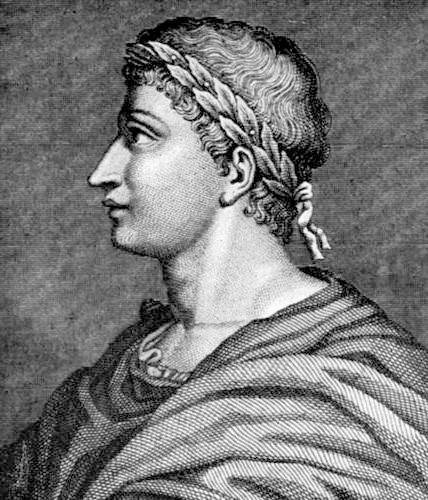
(A depiction of Ovid, Wikimedia Commons)